LYNQORE does not stop at detecting that something looks different. It determines whether that difference is forensically meaningful.
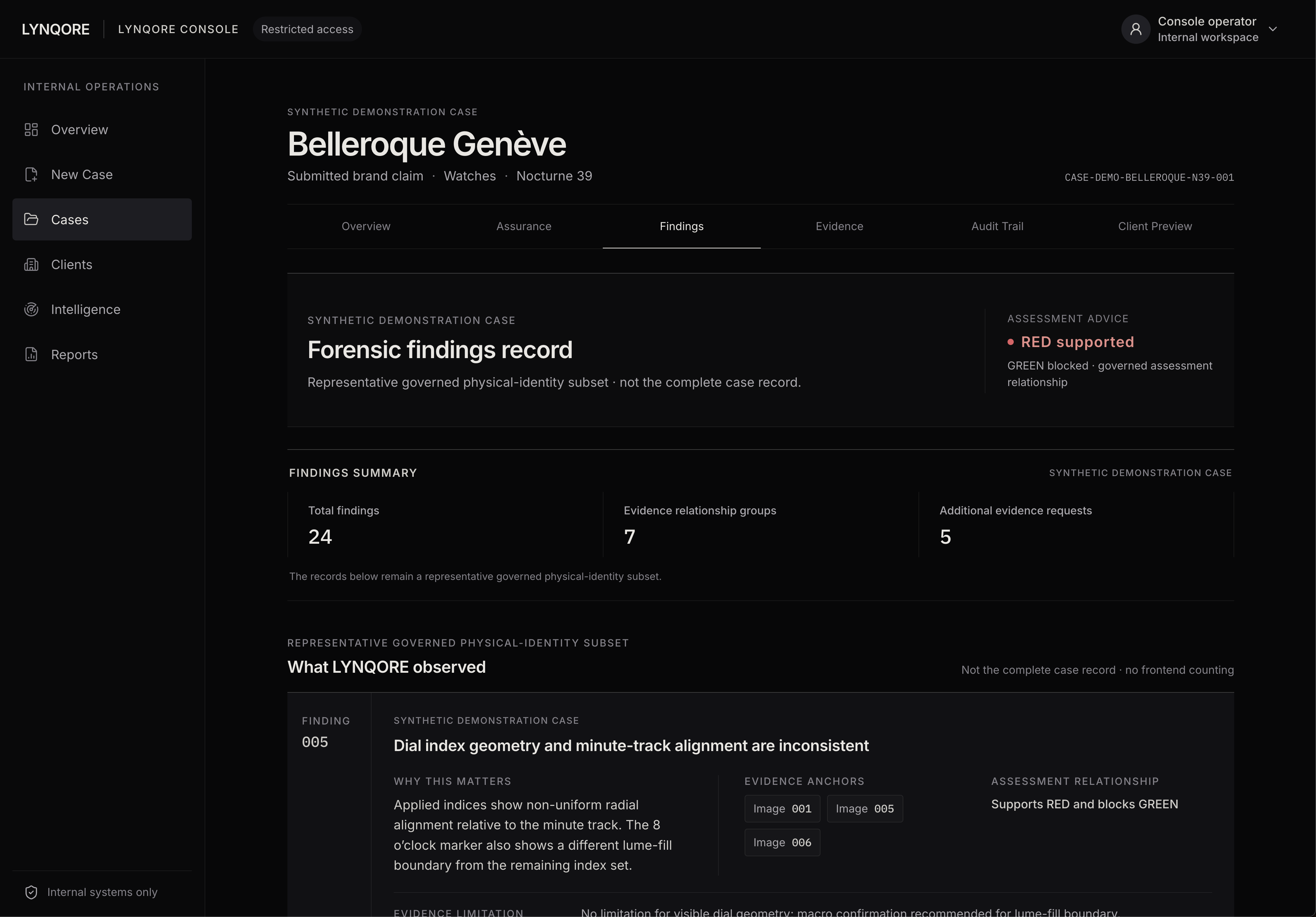
A visual observation does not automatically become a finding, and a finding does not automatically influence the conclusion. LYNQORE examines each relevant signal in context: whether the observation is sufficiently supported, whether it is consistent across the submitted evidence, whether other evidence confirms or contradicts it, what limitations apply, and whether it is permitted to contribute to the assessment.
This creates a deliberately deep reasoning chain from observation → forensic finding → governed evidence → cross-evidence interpretation → conclusion.
Weak, ambiguous or unsupported signals can be prevented from influencing the outcome. Contradictions remain visible rather than being averaged away. Contributing findings remain connected to the evidence from which they originated.
That is a fundamentally different model from a black-box AI tool that returns a similarity score, probability or classification without preserving the forensic reasoning underneath it.
The customer may receive a concise result. Behind that result can sit a substantial governed forensic record containing the evidence, findings, limitations, relationships and reasoning that produced it.
The precision is not only in what LYNQORE finds. It is also in what LYNQORE refuses to count.
We do not ask you to trust a score alone. We preserve the forensic record behind the conclusion.